
Liz-Marketing-Sources & Info Blog

The World Traffic Club has its own commission structure that is separate from the commissions offered
by individual WTS programs.
The Club commission levels are:
- Free: 25%
- Monthly/Yearly: 35%
- Lifetime/Founder: 50%
The commissions offered by the individual WTS sites remain separate, so joining the Club does not replace
the normal commission structure of those programs.
Two Separate Earning Opportunities
For someone interested in the earning side of the network, there are essentially two areas to consider.
Individual WTS Programs:
Each participating site has its own referral program and commission structure.
World Traffic Club:
The Club has a separate referral commission based on the member's Club level.
This means the Club is not simply another advertising site. It also has its own referral program.
Priority Support
Upgraded Club members can also receive priority support and access to certain assistance and updates.
For people who use multiple services within the network, having an additional support option can be
helpful when questions come up.
Banner Exposure Through BagsOfAds
The Club also provides banner exposure through BagsOfAds.
A 125 x 125 banner can be displayed across participating WTS sites, providing another way for members
to get their website or offer in front of other network users.
Personal TVTrafficAds Page
Club members can also receive a personal page through TVTrafficAds.
The page can be used to display the member's advertisements and also includes promotion for the World Traffic Club.
This provides another location where a member's advertising can be viewed.
Footer Rotation in WTS Mailers
Another feature is the footer rotation used with the WTS mailers.
A member's Recommended Site and Club referral URL can be included in the footer of outgoing emails. As other
members send their mailings, those links can receive additional exposure through the network.
Why I Included This Information
I wanted to explain the World Traffic Club here because it is one of the resources that can be useful to people who
are interested in online advertising, traffic exchanges, mailers, and other forms of website promotion.
There are quite a few features within the Club, and they may not all be immediately obvious when first looking at
the program. Hopefully, this overview makes it easier to understand what the Club is, how the different features work,
and how it fits into the larger WTS network.
As with any outside service listed as a resource, membership and upgrades are optional. It's always a good idea to look
over the features, pricing, and terms for yourself and decide whether the service fits your own marketing needs.
Liz J
Understanding the World Traffic Club and Its Features
If you use several advertising and traffic sites within the World Traffic Services (WTS) network,
the World Traffic Club is designed to make working with those sites more convenient.
The Club provides a central place to connect participating WTS sites and access additional features.
Membership is available as Free, Monthly, Yearly, or Lifetime, so members can choose the level that
works best for them.
Here is an overview of some of the features available through the Club.
Free Membership and Upgrade Options
You can join the World Traffic Club without paying for a membership. If you decide that you want access
to additional Club features, there are Monthly, Yearly, and Lifetime upgrade options.
The different membership levels also have different commission rates for referring others to the Club.
Access Across Multiple WTS Sites
The World Traffic Club connects participating sites within the WTS network. This can be useful for people
who use several of the network's advertising and traffic services rather than managing each one completely
separately.
The Club currently provides access to premium features across 15 sites.
Magic Button for Easier Access
One of the convenience features is the Magic Button.
Once your accounts are connected, the Magic Button allows you to move directly into a connected site without
having to repeatedly go through the normal login process. This can save some time when working with several sites.
Moving Funds Between Connected Sites
Club members can also transfer available wallet funds between connected sites.
This can be useful when you have funds available on one WTS site and want to use them for advertising or credits
on another connected site.
Six Mailer Services
The WTS network includes six mailer platforms that can be used for sending advertising emails.
For members who regularly use mailers to promote websites, programs, or offers, having several mailer services
available can provide additional places to advertise and reach other members.
Opening Multiple Sites
Another time-saving feature is the ability to open several connected sites at once.
For example, someone who wants to use all six mailers can open them together rather than opening each website
individually. This can make it easier to work through daily advertising activities.
Traffic Exchanges
The WTS network also includes traffic exchanges where members can surf and earn credits while viewing other
members' websites and advertisements.
Examples include Surf4Quality, WorldwideTE, and JustGoodTraffic.
The Magic Login feature can also make it easier to move between connected traffic exchanges without having
to repeatedly log in.
Tomorrow we will let you know about the earning opportunities,
Until then keep looking at your options
Liz Jeanminette
It's World Traffic Club
Your Online marketing dashboard that connects
multiple traffic exchanges, viral mailers, and
promotion tools into a single platform.
Key Features
Single Dashboard: Manages multiple safelists,
traffic sites, and promotion links from one place
instead of opening dozens of browser tabs.
Magic Login:
Offers one-click or streamlined logins
to connected marketing and traffic sites.
Promo Tools:
Includes page builders, lead capture tools,
and pre-written email swipes.
Network Access:
Integrates with 16+ marketing platforms,
allowing members to scale advertising and reuse promotional
campaigns. If you're looking into this platform, would you
like to know That it works.
Liz J.
Take a look at the numbers, this is a Live Network Service. As things are happening it shows in the numbers.
29,489 Unique Current Members 17,712,914Emails Sent • Last 30 Days 77,660 Member Click Activity • Last 30 Days 824,654
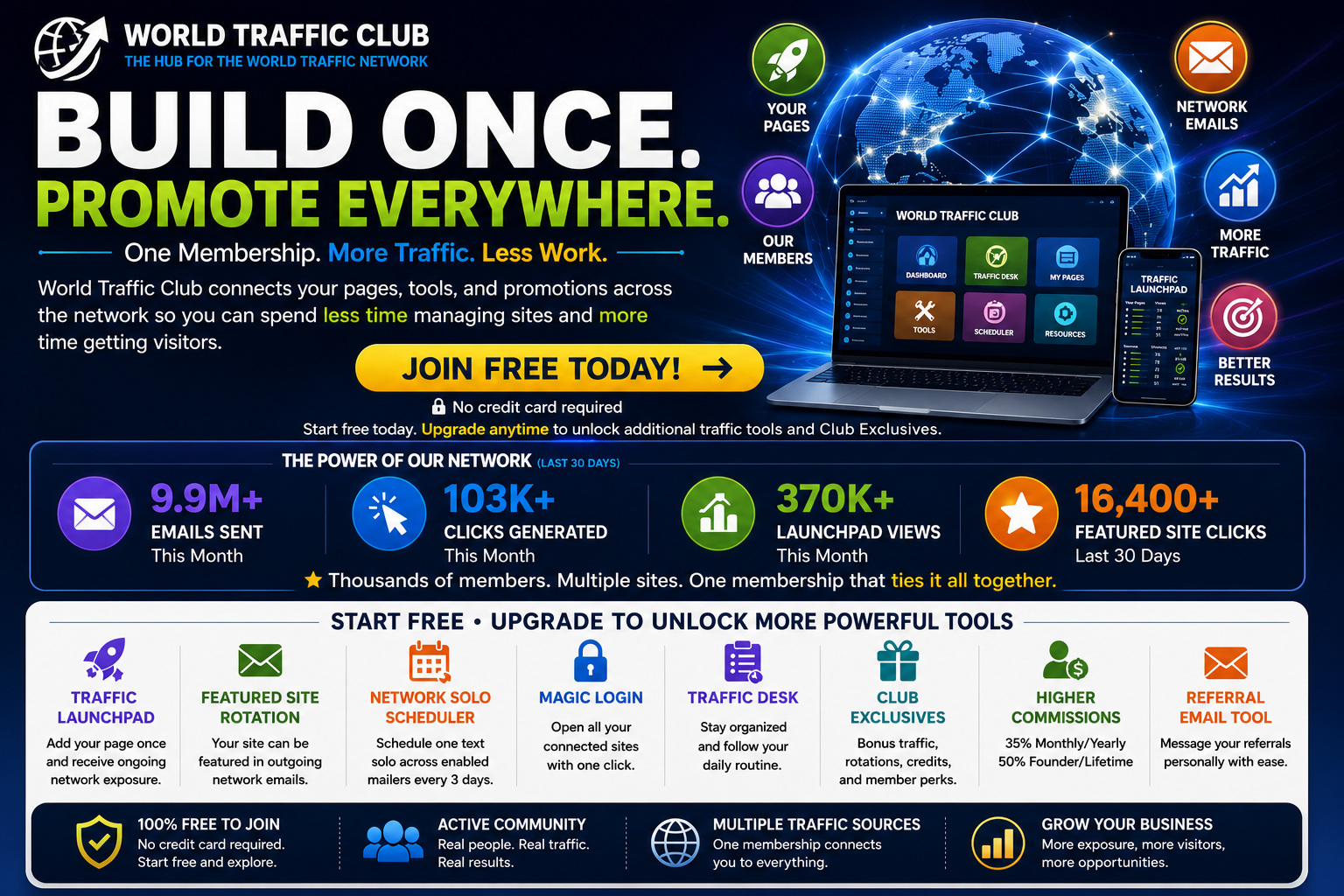
World Traffic Club brings multiple traffic and advertising resources together in one place..without having to search for different traffic opportunities on your own.
It gives you a Central Place to find and work with different traffic and advertising opportunities.
It may be something useful to add to your own promotion strategy.
I work with this everyday, this is the guide for making my marketing easier.
more to come.
Liz
Some Friendly Advice from a Very Good Friend
My friend Kimberly Smith, MD Internal Medicine
Passes this information to me every month I just
would like to share it with you. Not that you
need to do anything with it just read it a learn.
What’s Your Biological Age
Did you ever notice that some people look great for their age, while others may look older than their actual age? It’s because everyone ages according to their own biological clock.
It may sound a little silly, but you actually have two ages – your chronological age and your biological age. Both ages are important and help determine your life expectancy. However, you may want to pay more attention to your biological age or at least the variables that define it, because many of them are controllable. My colleague, Dr. Andrea Klemes, chief medical officer at MDVIP, explains why below.?
In good health,
Dr. Smith
What’s Your Biological Age?
By Andrea Klemes, DO FACE
Everyone ages. It’s a process that none of us can avoid despite how well we care for ourselves. There are two basic types of aging – chronological and biological. And while you experience both, one type of aging can happen faster than the other.
Chronological aging is what we think of when we think of aging. It’s the age on your driver’s license. Biological aging, however, is the amount of cellular and tissue damage that’s accumulated over time.
Scientists have used years of genetic information, advanced molecular biology testing and machine learning to establish biomarkers or “clocks” that define biological age. If a person is chronologically 60 years old but has biomarkers of a 50-year-old, their biological age may be closer to 50. And of course, a 60-year-old with biomarkers of a 70-year-old is considered biologically 70. This helps explain why people of the same age may look, move or just seem older or younger than their chronological age.
Biological aging is complicated – and so is the science behind it. Your doctor is your best resource for understanding how you’re aging and for guiding you on the steps to slow down your biological clock and improve your health. Make sure you talk to your doctor before making any major lifestyle changes. Your doctor knows your health history and can help you pursue healthier choices at an appropriate pace.
Your Body Ages at Different Rates
For example, new research indicates that our biological aging, unlike our chronological aging, isn’t linear. Stanford University researchers believe internal biological aging occurs at various rates, because our genes express themselves at different times during our life, according to a study published in Nature.
This means that your body doesn’t age at a steady rate. Instead, parts of your body, like organs, age on their own timeframe. This is probably why some people develop diseases earlier in life. The concept has led to a new area of research referred to as “organ aging,” which involves studying how quickly different parts of the body age and how it affects our overall health and longevity.
Despite all the research, the science behind biological aging is still pretty new – and testing, which can range from free online surveys to expensive DNA tests, may not produce accurate results.
How Biological Age Is Determined
For consumers, there are multiple tests available that gauge biological age. The most common – and cheapest — are online calculators, which are based on a lifestyle questionnaire and your health history. The most famous is the Real Age test, which is based on thousands of studies. You can take the Real Age test here, but it requires setting up an account.
Other online tests abound. They’re simple, affordable and provide some helpful information. But they’re based on your habits and medical history — not on what’s specifically going on in your body.
More sophisticated testing measures our bodies ages down to the DNA level. For example, the length of your telomeres can suggest biological age. In simplest terms, telomeres are the end caps of chromosomes, which are the long, thread-like structures that contain DNA (genetic information) found in the nucleus of cells.
Telomeres prevent chromosomes from fraying, like the plastic tips on the ends of shoelaces. Telomeres also have additional function and serve as markers for our biological age. Each time a cell divides, the telomeres shorten and eventually become too short to divide. Shorter telomeres are associated with age-related illnesses such as heart disease, dementia, cancer and diabetes.
Telomere testing exists for certain conditions. Your doctor may prescribe a telomere length test to help diagnose bone marrow failure, dyskeratosis congenita (a bone marrow failure syndrome) and pulmonary fibrosis. Or your doctor may order the lab test as a part of managing myelodysplastic syndromes (cancers involving blood-forming cells in the bone marrow), acute myeloid leukemia and liver failure.
If you’re curious about your biological age, you could go online to buy an over-the-counter qPCR telomere measurement kit. These tests involve a blood sample, and the price generally ranges between $100 and $400. Before you order one, however, consider that these tests are controversial. They have wide variability rates and may not give you an accurate picture of your biological age. For example, one study found no correlation between telomere length in older women and cognitive health. Additional studies have found links between longer telomere length AND shorter telomere length and Alzheimer’s disease.
Another test looks at your epigenetic age. Epigenetics is the study of how our lifestyle and environment affect our genes. Eating a poor diet, smoking, living a sedentary lifestyle, and being exposed to environmental chemicals can affect our DNA, change how our body works with our genetic code and interrupt cellular functions. This raises the risk for age-related chronic conditions.
Epigenetic changes are reversible, however, because they don’t damage the underlying DNA sequence.
For example, in human studies of identical twins, researchers have looked at the difference in lifespans of these genetically identical people. They speculate that when two twins have different biological ages, the difference is related to epigenetic drift due to lifestyle behaviors that aren’t identical.
To understand your epigenetic age, researchers developed techniques or epigenetic “clocks” to quantify how these changes translate to a biological age. An epigenetic age test uses a blood or saliva sample and often costs a few hundred dollars. Like the qPCR telomere length tests, however, the results may be better for researchers than for consumers.
All of these tests can help guide discussions about our health with our doctors. But they need to be combined with other, conventional medical tests to help us understand our biological ages.
Slowing the Biological Aging Process
The good news is we don’t need to know our biological age to slow down the biological aging process and even reverse it. In fact, you probably already know the things that you can improve to get to a younger biological age. Here are seven tips that can help.
Get plenty of exercise. Exercise keeps us young in a variety of ways. It promotes insulin sensitivity, which helps our bodies convert the nutrients we eat to power our cells. Exercise helps us manage our cholesterol levels and lower high blood pressure, which helps our hearts. It can even thin our blood, which may lessen the risk for blood clots. Even if our chronological ages are high, exercise can still positively impact our biological age.
Maintain a healthy weight. This can also extend our biological age. In fact, gaining weight as we age is associated with shorter telomere lengths. Being overweight also puts pressure on our heart, raises our risk for multiple chronic conditions including type 2 diabetes, hypertension and cancer and makes getting around harder.
Quit smoking. Nothing increases biological age quite as much as smoking. One study found that epigenic aging is directly linked to smoking. Exposure to cigarette smoke harms our DNA, ups our risk for cancer and damages our heart.
Our diet also profoundly impacts how we age biologically. Studies show that people who eat a diet rich in fruits and vegetables, whole grains, nuts and legumes and healthy proteins like fish live longer. Studies have also shown that what we eat has a positive relationship to biological aging.
Controlling our stress can also help reverse biological aging, at least in mice. Many studies have connected stress with shorter lifespans. If you have high levels of stress or anxiety, let your doctor know. They can help you manage it, and hopefully, slow your biological aging.
Like stress, not enough sleep is also linked with a higher biological age and a shorter lifespan. Lack of sleep can interfere with the body’s natural repair process, resulting in shorter telomeres. Too much sleep can have a negative effect, too, which is why doctors recommend you sleep between seven and nine hours a night.
Finally, it may be a buzzkill, but alcohol consumption is also linked to biological aging. Cutting back or eliminating alcohol altogether can cut years off your biological clock.
Biological aging is complicated – and so is the science behind it. Your doctor is your best resource for understanding how you’re aging and for helping you take the steps to slow down your biological clock and improve your health. Make sure you talk to your doctor before making any major lifestyle changes. Your doctor knows your health history and can help you make healthy choices at an appropriate pace.
Kimberly Smith, MD
Internal Medicine
520 North Lewis Street Suite 100
New Iberia, LA 70563